




Case study · Door and cabinet hardware shop · Lakkar Bazar, Ludhiana
Birdi Hardwares: a searchable hardware catalogue for a Ludhiana shop
Customers of a hardware shop arrive with a model code, a photo of an old fitting or a measurement, and the price depends on the finish and the quantity. We designed and built this site so they can find the exact part and send the shop a precise question.
Website project · live website we designed and built. Shown as a work example, not an independent client result.
- The business
- A hardware shop in Lakkar Bazar, Ludhiana (Punjab). Per its own site: cabinet handles, knobs, pull handles, wardrobe fittings, locks and door hardware.
- Who the site is for
- People fitting out or repairing doors, kitchens and wardrobes, and buyers for larger jobs, who need the right part and then a price from the shop.
- Language
- English
- Our role
- Designed and built the website: the visual identity, the catalogue built from two manufacturers’ catalogues, the guides and the enquiry routes.
- Scale today
- 786 product pages from 6 manufacturers’ catalogues in 26 catalogue categories, 8 door-hardware range pages, 4 pages by need (main door, interior doors, renovation, trade) and 6 buying guides; 840 URLs in its own sitemap (as of 14 November 2026).
- How it is run
- A static Astro site served by Cloudflare at birdihardwares.com.
The problem
The same handle can come in several finishes and lengths, and a buyer usually knows only part of what they need: a model code from the old fitting, a finish, or a measurement. A list of categories with a phone number does not get them to the exact part.
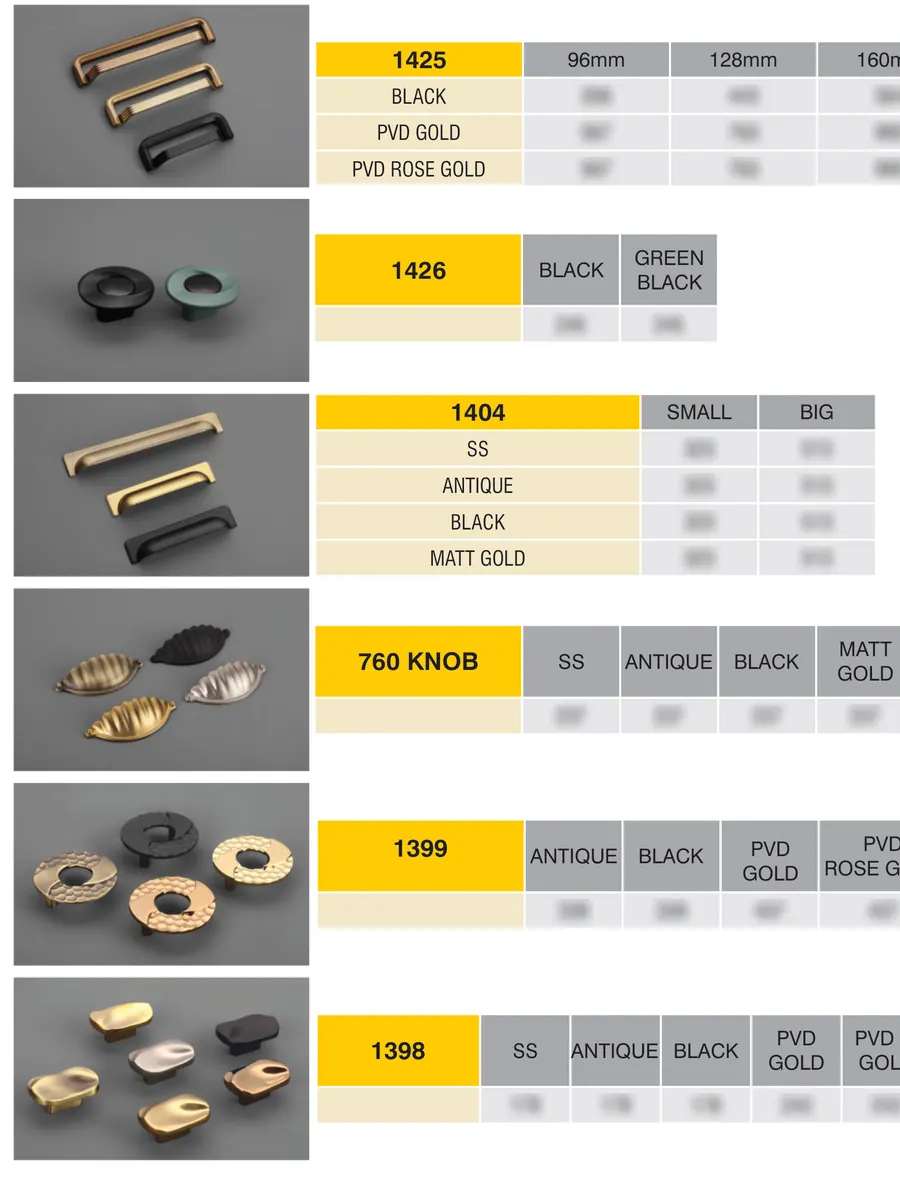
The product information existed only in two manufacturers’ printed catalogues (FANCY and ROOT). Every item is priced on request, so the site has to end in a clear question to the shop, not in a cart.
What we delivered
Visual design
- An ivory, walnut and brass look with the Jost typeface and a new mark and wordmark for the shop. Product photographs sit on a neutral ground so the finishes are easy to compare.
- The home page image and motion are labelled on the page as an illustration generated with Higgsfield, not a photograph of the shop’s stock. Original 3D scenes and a 26-second film made for the site are labelled as renders.
A searchable catalogue
- 786 products from 6 manufacturers’ catalogues and price lists (as of 14 November 2026), each with its own page, in 26 categories, the larger ones split into sub-groups (cabinet handles, for example, into white metal, aluminium and recessed sliding handles).
- One search box finds products by name, model code, finish or brand and updates the result count as the visitor types (134 products for “rose gold” when we checked), with category and brand filters beside it.
- Category pages list each product with the number of finishes and sizes the catalogue gives for it, so a buyer can see the choice before opening the page.
Product pages
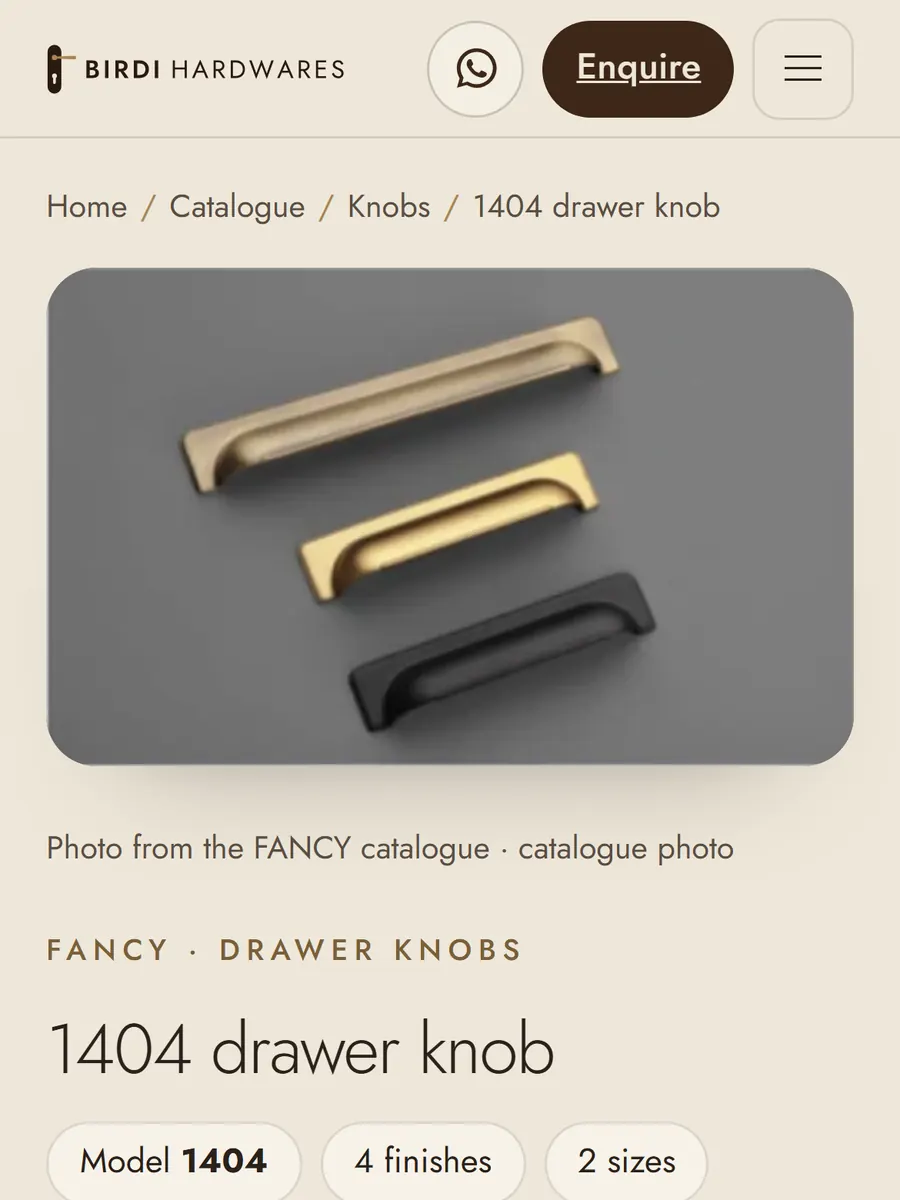
- Each product page shows the brand, the model code, the finishes and sizes printed in the catalogue, and the catalogue page it came from (for example “FANCY catalogue, page 8”).
- The buyer chooses a finish and a size, or “any or not sure”, before asking. The page states that not every finish is made in every size and that the shop confirms availability and price.
- Related products from the same group, and structured data that describes the shop, the breadcrumb trail and the product page to search engines.
The enquiry journey
- “Ask on WhatsApp” on a product page opens a message with the product, finish and size already written. The buyer checks it and presses send.
- A quotation form asks for what decides the fit (item, quantity, door type, door thickness, backset, door width and finish) and opens the enquiry in WhatsApp, addressed to the shop.
- A call link in the header, and a WhatsApp button that stays on screen while the visitor browses the catalogue.
Guides and the phone experience
- 8 door-hardware range pages and 6 buying guides (choosing a door lock, digital or mechanical, door closers, hinges, finishes and materials, and a door measurements checklist) that say what to measure before asking.
- On a phone the search, the filters and the finish and size choices stack into one column, and the WhatsApp and call buttons stay within reach of the thumb.
Under the hood (checked on the live site, 31 October 2026)
- One page per product at a lasting address built from the brand and model code (for example /catalogue/cabinet-handles/fancy-11070/), each with its own canonical URL.
- Titles and descriptions written from the catalogue data, so each page names its brand, model, finishes and sizes, for example “FANCY 11070 cabinet handle”.
- An XML sitemap listing every page (840 on 14 November 2026), referenced from robots.txt; the not-found page is marked noindex.
- Structured data that matches what is on the page: the shop (HardwareStore with its address), a breadcrumb trail, and the product page and its image. No price or review markup, because every item is priced on request and the site has no reviews.
- Product photographs served as WebP and loaded lazily below the first screen.
One printed page. Then a page customers can find.
Page 33 of the catalogue, with prices blurred here, and the same 1404 drawer knob as its own page on the site. Drag the handle to compare.
Screenshots
Captured from the live site on 27 October 2026. Desktop views at 1440 × 900, phone views at 390 × 844. The search shows the live result for “rose gold”; the product page has a finish and a size chosen. Nothing was sent.
Select a screenshot to open it at full size. Numbered markers point to the features described under each one; the enlarged view shows the original capture without markers.
- One search box: name, model code, finish or brand.
- Category and brand filters beside the search.
- The result count updates as the visitor types.
- Each result names the brand, the group and the model.
- How many products, and from which manufacturer’s catalogue.
- Sub-groups with their counts filter the list in place.
- Each product shows how many finishes and sizes the catalogue lists.
- The manufacturer’s catalogue photo, labelled as such.
- Finish and size, as printed in the catalogue.
- WhatsApp opens with the product, finish and size written in.
- The catalogue and page the product came from.
- Says plainly that the enquiry opens in WhatsApp for the visitor to check and send.
- Door thickness, backset and width: the measurements that decide what fits.
- A measurements checklist and the shop’s address beside the form.
How enquiries reach the business
The site has three routes to the shop. Each one ends in a message or a call that the buyer makes themselves.
- WhatsApp from a product page
- Opens WhatsApp with the product, finish and size already written. The buyer checks the message and presses send; the website sends nothing itself.
- Quotation form
- Collects the item, quantity and measurements, then opens the same enquiry in WhatsApp, addressed to the shop. The website does not store what is typed.
- Phone
- A call link in the header and on every product page.
Limit: Every enquiry leaves from the buyer’s own WhatsApp or phone, so the website keeps no record of enquiries and we cannot publish a count.
What happened, and what we can and cannot say
The site went live on birdihardwares.com in October 2026. We have no enquiry, traffic or sales figures to publish for it.
- We cannot say how many enquiries the site has produced, or whether any led to a sale.
- The product counts describe the catalogue, not stock: the site itself says the shop confirms availability and price.
Speed in a lab test (not real-visitor data)
- Our own test on 31 October 2026: Lighthouse 13.5.0, mobile emulation with simulated throttling, headless Chrome. Three runs per page; the median run is shown.
- FANCY 11070 product page: performance score 100 in all three runs. First contentful paint 1.1 s, largest contentful paint 1.4 s, total blocking time 0 ms, layout shift 0.
- Home page: performance score 70 (runs: 68, 70, 74). First contentful paint 1.2 s, largest contentful paint 2.4 s, total blocking time 1,400 ms, layout shift 0. The blocking time comes from the home page’s 3D scene and film; the catalogue pages do not load them.
A lab score is one machine’s simulation and varies from run to run. It is not the experience of real visitors and says nothing about rankings or enquiries.
No testimonial is published for any of our projects: none has been verified, and we do not write one on anyone’s behalf.
What would carry over to your project
Fits the packages
- A searchable catalogue with one page per product, built from the supplier catalogues a shop already has.
- Finish and size choices that go straight into a WhatsApp enquiry.
- Buying guides that tell visitors what to measure before they ask.
The three packages describe how many pages each covers, and what is and is not included.
Not part of a package unless agreed in writing
- The 3D scenes and films made for this site: creative work, quoted separately.
- Online payments, stock levels or a cart.
Depends on you
- Readable catalogues or product files from your suppliers. Model codes, finishes and sizes come from them, so the catalogue can only be as complete as they are.
This project is larger and more specialised than a typical first project. Read it as an example of the approach, not as a price list. See also the Samrat Poly Resins case study for a different audience and a different enquiry route.
Related
Where this fits in our services and guides.
- Product catalogue websites
Websites for manufacturers and B2B suppliers with many products: categories, product pages, data sheets and quote routes, shown with three live sites.
- Distributor and dealer websites
Websites for distributors, distribution companies and authorised dealers: brands carried, product lines, territory, trade enquiries and proof of authorisation.
- Small business web design
Website design for small businesses, SMEs, MSMEs, startups and new companies: fixed INR packages, what you get, what you supply and how to get a quote.
- How to organise a product catalogue website
A catalogue works when a buyer can get from a need to the right product in a few clicks. This is a practical structure, with a worked example and honest limits for sites without a search engine of their own.
- WhatsApp on a website: button, form or chat
A WhatsApp link takes minutes; a chat widget is a project. Here are the options, what each tracks, the privacy points and the mistakes that cost enquiries.
- Catalogue website, online store or microsite?
Many businesses ask for an online store when they need a catalogue that brings in enquiries. The difference is who completes the sale, and it changes the cost, the risk and the provider you need.
Want a site like this for your business?
Tell us what you sell and who buys it. We’ll suggest the package that fits and send a written proposal with the scope, price and timeline.
Harman Singh Bagga · +91 77196 70215
More ways to get in touch