
Case study · Resin manufacturer · Doraha, Ludhiana
Samrat Poly Resins: a manufacturer’s catalogue and quotation website
A resin manufacturer sells to technical buyers who compare grades and ask for a quotation, not to shoppers who add to a basket. I designed and built this site around that, and I help manage it.
- The business
- A resin manufacturer in Doraha, Ludhiana (Punjab). Per its own About page: polyester, gelcoat, fire-retardant, specialty and epoxy resins, plus hardeners and FRP materials.
- Who the site is for
- FRP and composite manufacturers and their buyers. The site says it supplies across India and exports to Nepal and Bangladesh.
- Language
- English
- My role
- Designed, built and help manage the website.
- Scale today
- 302 URLs in its own sitemap, 51 products in 9 categories, 40 application guides (counted 11 October 2026).
- How it is run
- A static Astro site on Cloudflare Pages, deployed from a private GitHub repository.
The problem
A manufacturer’s buyers need to find the right grade, check the technical data sheet and ask for a price on a quantity and a delivery location. A generic brochure site does not do that.
My own account, not a measured baseline: before this site the business found it hard to get enquiries through its website. I have no enquiry count from before the rebuild to compare with, so this starting point is described, not measured.
What I delivered
Structure for technical buyers
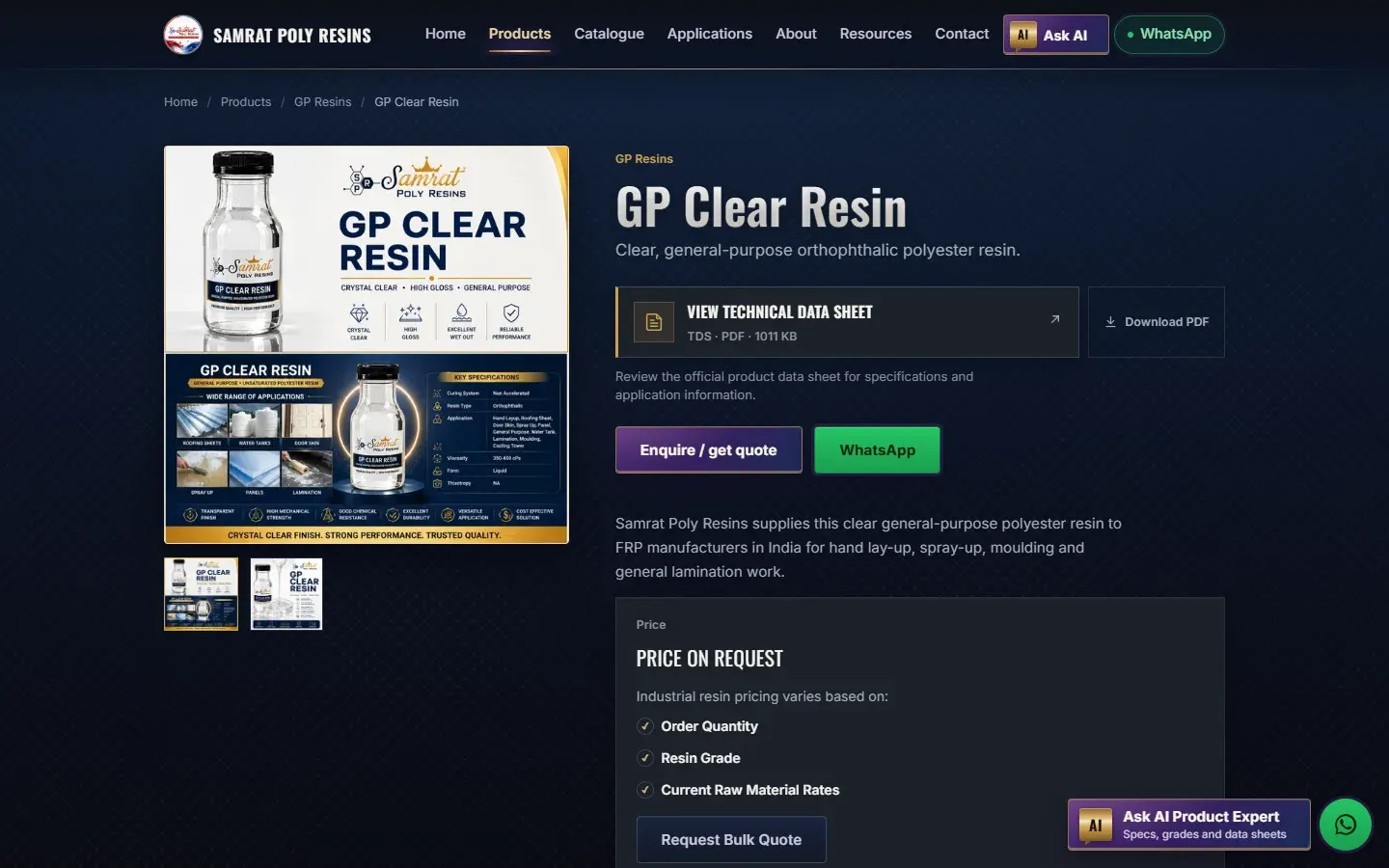
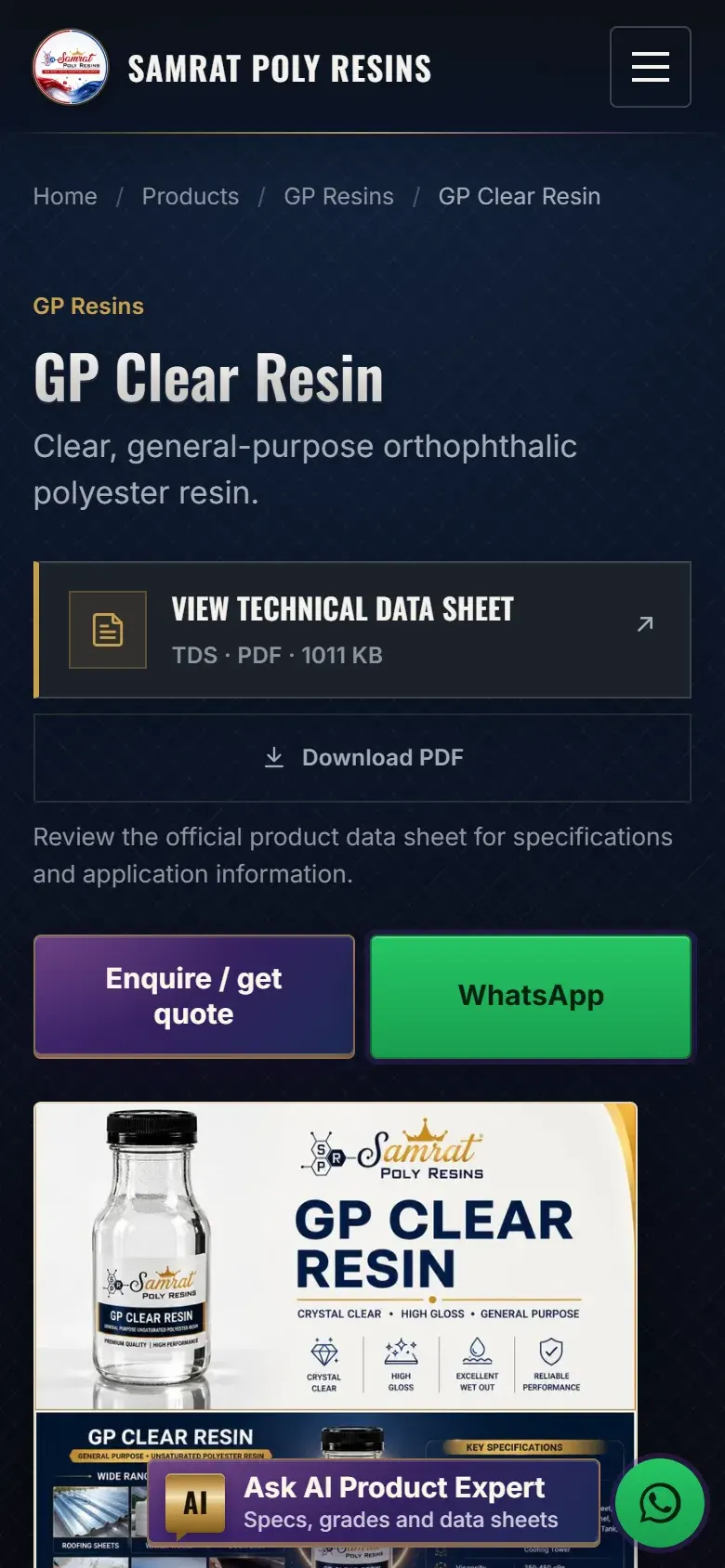
- 51 products in 9 categories. Each product page puts the data sheet (a downloadable PDF) beside the enquiry buttons, so a buyer can check the document and ask in the same place.
- 40 application guides that start from what a buyer is making (for example decorative panel lamination) and lead to the grades that apply.
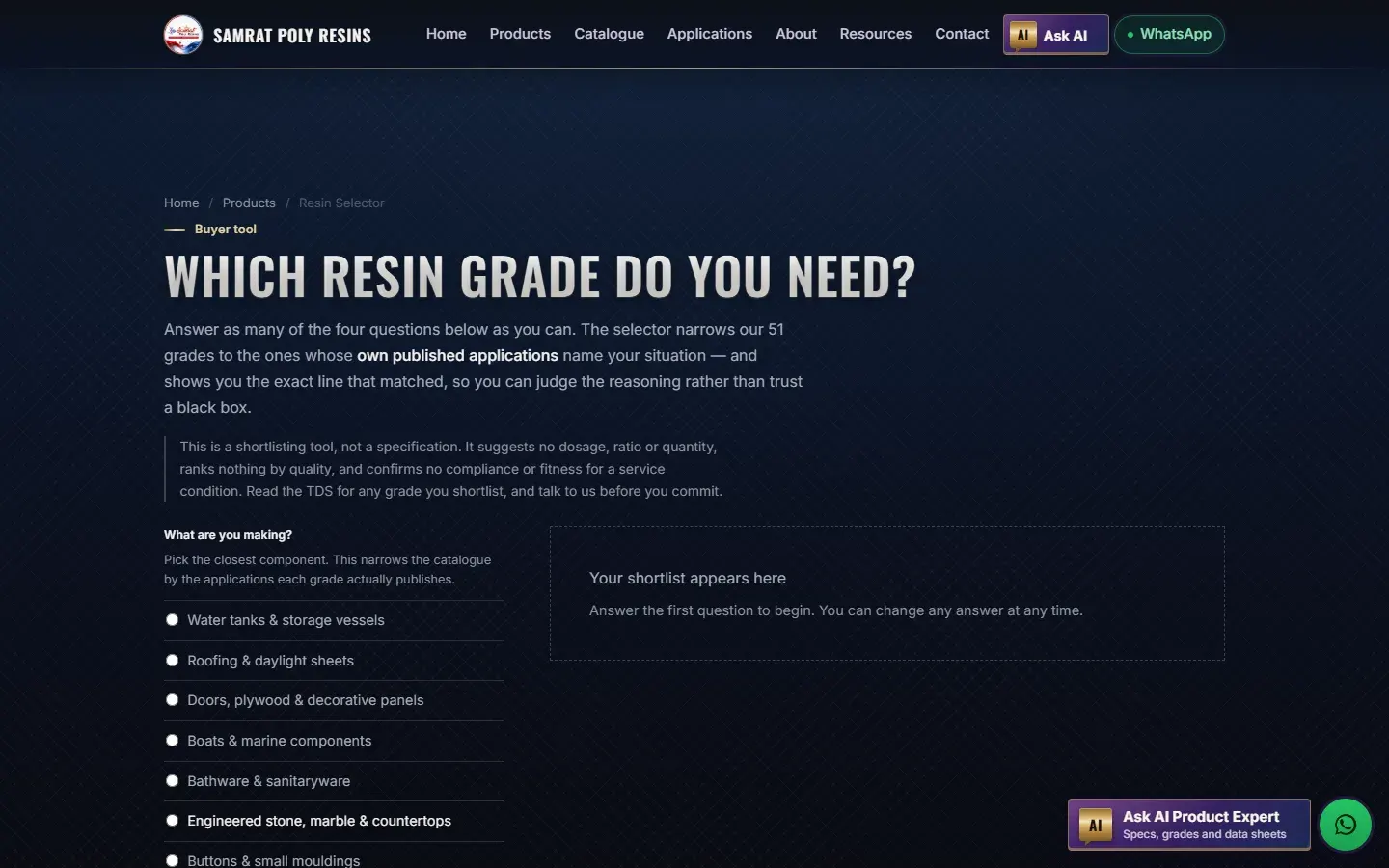
- A resin selector that narrows the range by what is being made and shows the published line that matched, so the buyer can check the reasoning. A quantity-guidance tool sits beside it.
- A knowledge centre of articles and guides (185 URLs in its sitemap section).
A buying route that matches how the business sells
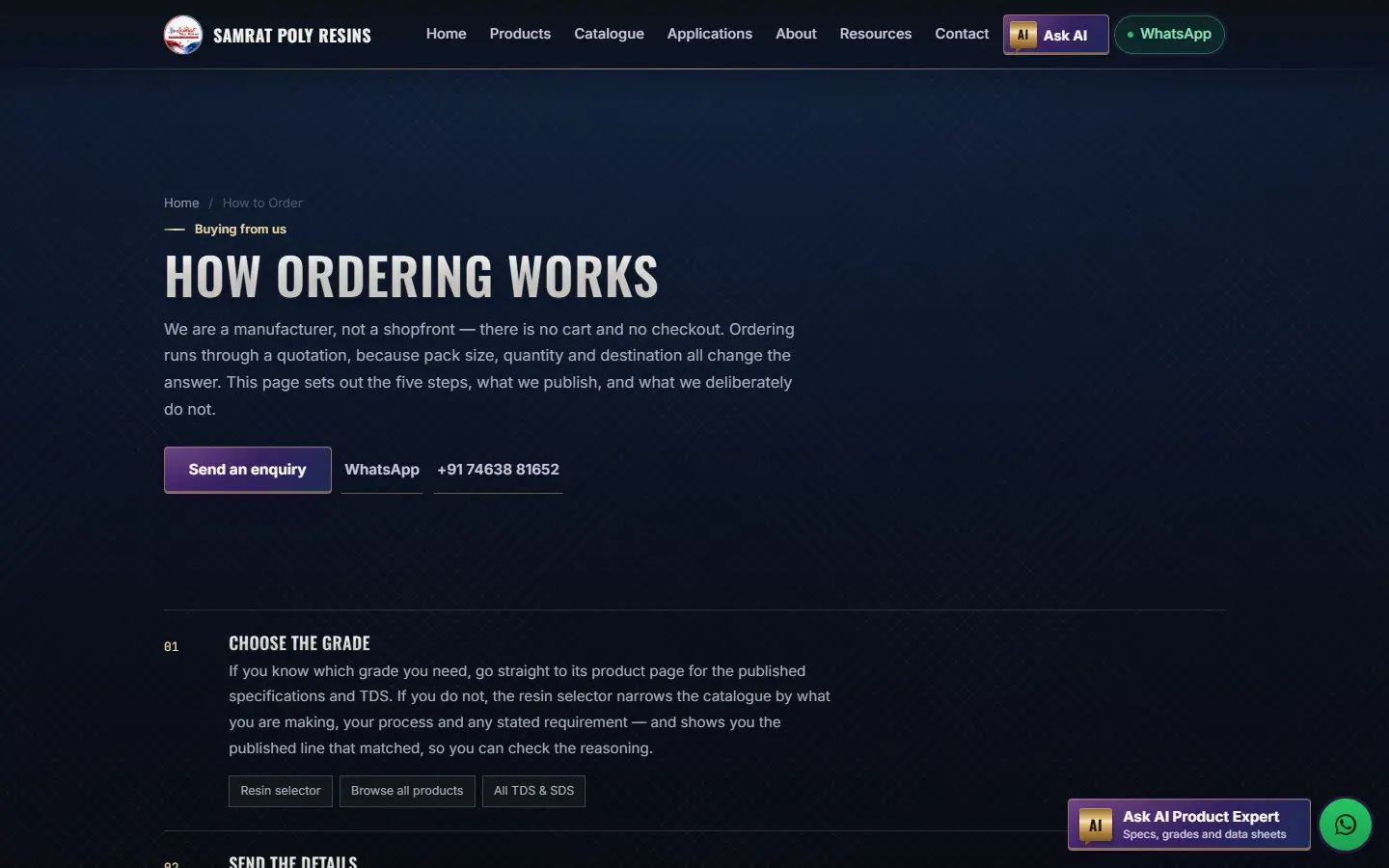
- A “How ordering works” page that says plainly there is no cart or checkout: ordering runs through a quotation in five steps (choose the grade, send the details, technical confirmation, quotation, confirmation and dispatch).
- A pack-size and minimum-order table generated from the same product records as the product pages, so the two cannot drift apart.
- A custom specification request for buyers whose requirement does not match a catalogue grade. The page states that it is a request, not a data sheet or an approval.
Enquiry paths
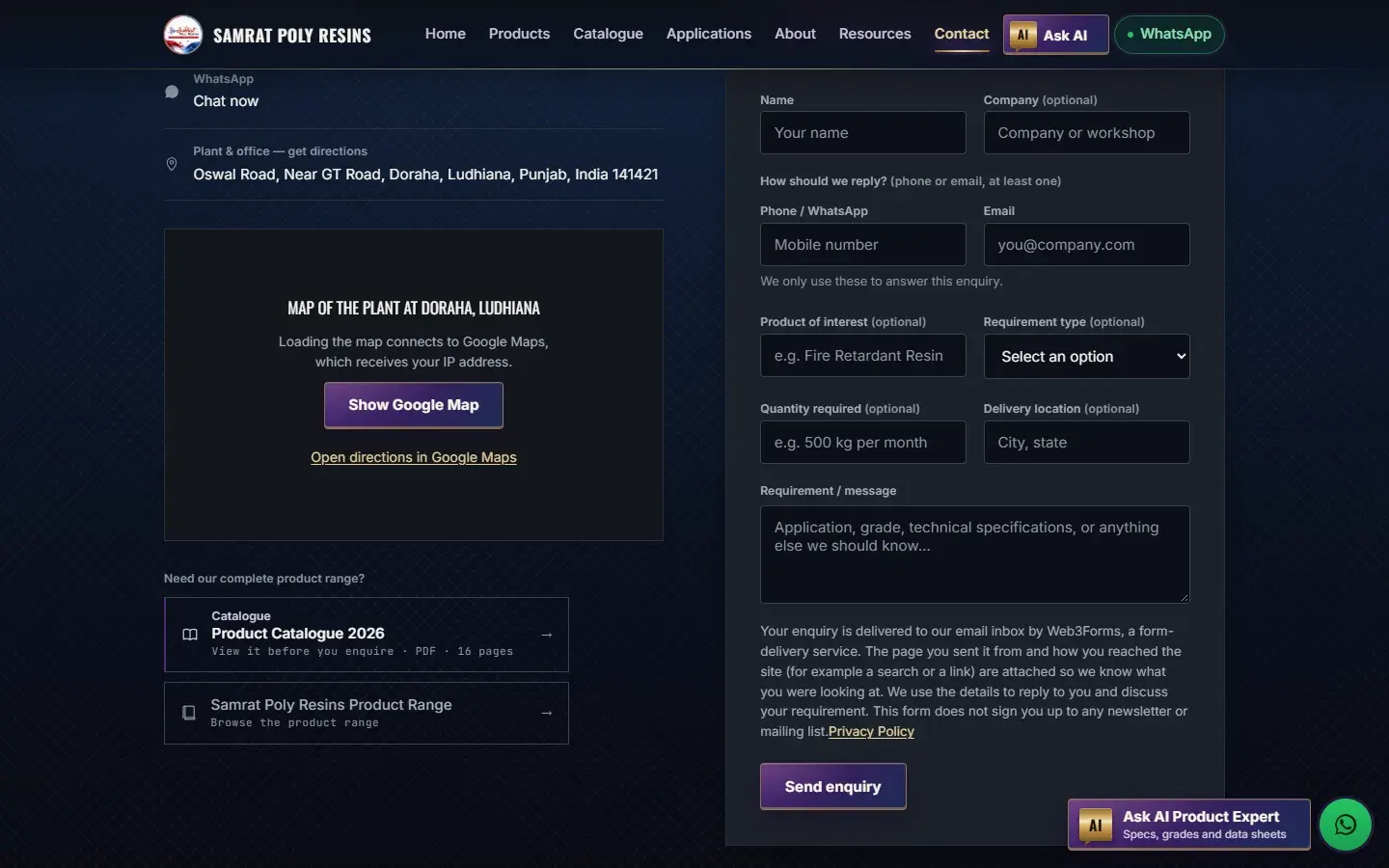
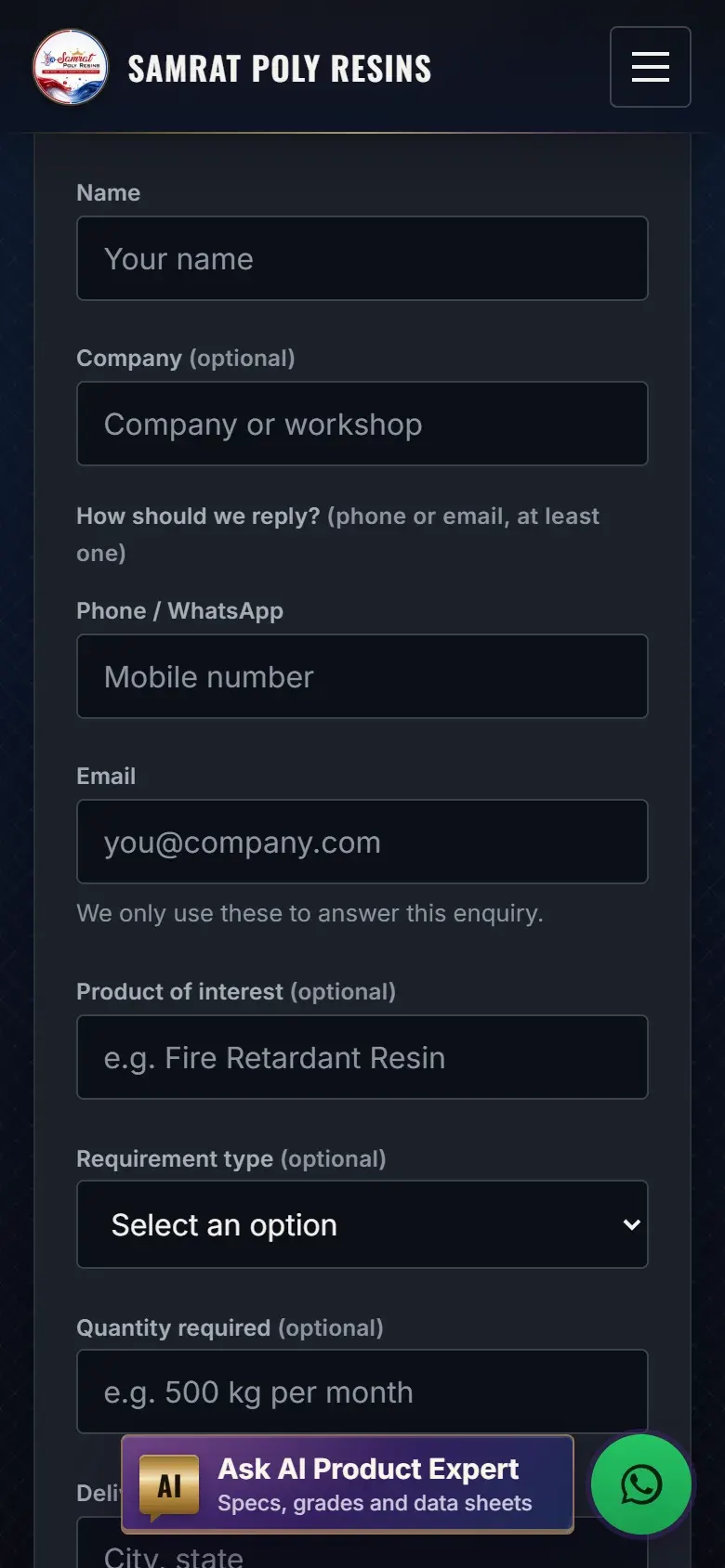
- An enquiry form (name, company, phone or WhatsApp, email, product, requirement type, quantity, delivery location, message).
- WhatsApp and phone buttons on the pages where a buyer decides.
- An AI product-expert assistant for specifications, grades and data sheets. This is a backend feature that was scoped for this business; none of my packages include one.
Documents and consent
- Privacy, cookie and terms pages, and an analytics prompt that waits for the visitor’s choice before anything loads.
Screenshots
Captured from the live site on 11 October 2026. The visitor-consent prompt was declined for the capture.
How enquiries reach the business
The business has three ways to be reached from the site. They behave differently, so I describe each one separately.
- Enquiry form
- The form posts to a form-delivery service (Web3Forms), which emails the business’s inbox. The page the visitor came from and how they reached the site are attached, so the business can see what the visitor was reading.
- A link that opens WhatsApp. Opening it is not the same as a message being sent.
- Phone
- Telephone links on the pages where a buyer decides.
Limit: I do not hold a log of the enquiries that arrive by these routes, so I cannot publish a count, and I cannot tell you how many were qualified buyers.
What happened, and what I can and cannot say
My own observation, not a measured result and not a customer quotation: since launch the business has received enquiries and WhatsApp messages through the site, some from outside India.
- I cannot say how many, which countries, or how many were serious. No before-and-after enquiry log exists to compare.
- I cannot say which enquiries came because of the website rather than the business’s other channels or existing customers.
- An enquiry from outside India is an enquiry, not a completed export order. I am not claiming any order.
The one measured record I have: Google Search Console
- Property: samratpolyresins.in (Domain property). Window: 1 August to 6 September 2026, read on 8 September 2026.
- 122 clicks and 5,108 impressions; average position 14.4.
- 105 of the 122 clicks came from India. The record names 3 from the UAE, 2 each from the United States and Kenya, and 1 each from the UK and Bangladesh; the remaining 8 are not broken down by country.
This is search visibility: people clicking a Google result. It is not enquiries, calls, or sales. Search Console held no data for this site before about 1 August 2026, so it cannot show whether anything changed over time.
No testimonial is published for either project: none has been verified, and I do not write one on anyone’s behalf.
What would carry over to your project
Fits the packages
- A clear category and product structure with one page per product.
- A published document next to each enquiry button, and an enquiry route on every page that matters.
- Pages written for the way buyers search and decide.
The three packages describe how many pages each covers, and what is and is not included.
Not part of a package unless agreed in writing
- The AI assistant, the form-delivery set-up and any other backend feature: not part of any package unless written into a proposal.
- Anything that needs accounts, bookings or online payments.
Depends on you
- The business has to supply the specifications, data sheets and photographs. They are facts about its products, so gathering them takes longer than building the pages.
This project is larger and more specialised than a typical first project. Read it as an example of the approach, not as a price list. See also the Samrat FRP Traders case study for a different audience and a different enquiry route.
Related
Where this fits in my services and guides.
- Product catalogue websites
Websites for manufacturers and B2B suppliers with many products: categories, product pages, data sheets and quote routes, shown with two live sites.
- Manufacturer and exporter websites
For manufacturers and exporters selling to unseen buyers: trust documents, quotation routes, markets and languages. Product layout is on the catalogue page.
- How to organise a product catalogue website
A catalogue works when a buyer can get from a need to the right product in a few clicks. This is a practical structure, with a worked example and honest limits for sites without a search engine of their own.
- How a quote request should work on a catalogue site
A catalogue site succeeds when a buyer can ask for a quote in a minute and you receive what you need to answer it. This note covers the fields, the routes and the follow-up.
- An AI chatbot on a business website: what to know
A chatbot can answer product questions at any hour, and it can also answer wrongly with confidence. Here is what it takes, what can go wrong and when not to bother.
Start with a conversation
Want a site like this for your business?
Tell me what you sell and who buys it. I’ll suggest the package that fits and send a written proposal with the scope, price and timeline.
Harman Singh · +91 62849 56077
More ways to get in touch